AI-Guided Steric-Block ASOs for Extrahepatic RNA Targets
High-affinity LNA mixmers that modulate RNA function without relying on RNase H cleavage or RISC loading. Designed by an AI engine that has been benchmarked against empirical screening. Built for subcutaneous saline dosing across heart, skeletal muscle, kidney, lung, and retina.
Heart & Skeletal Muscle Target Engagement
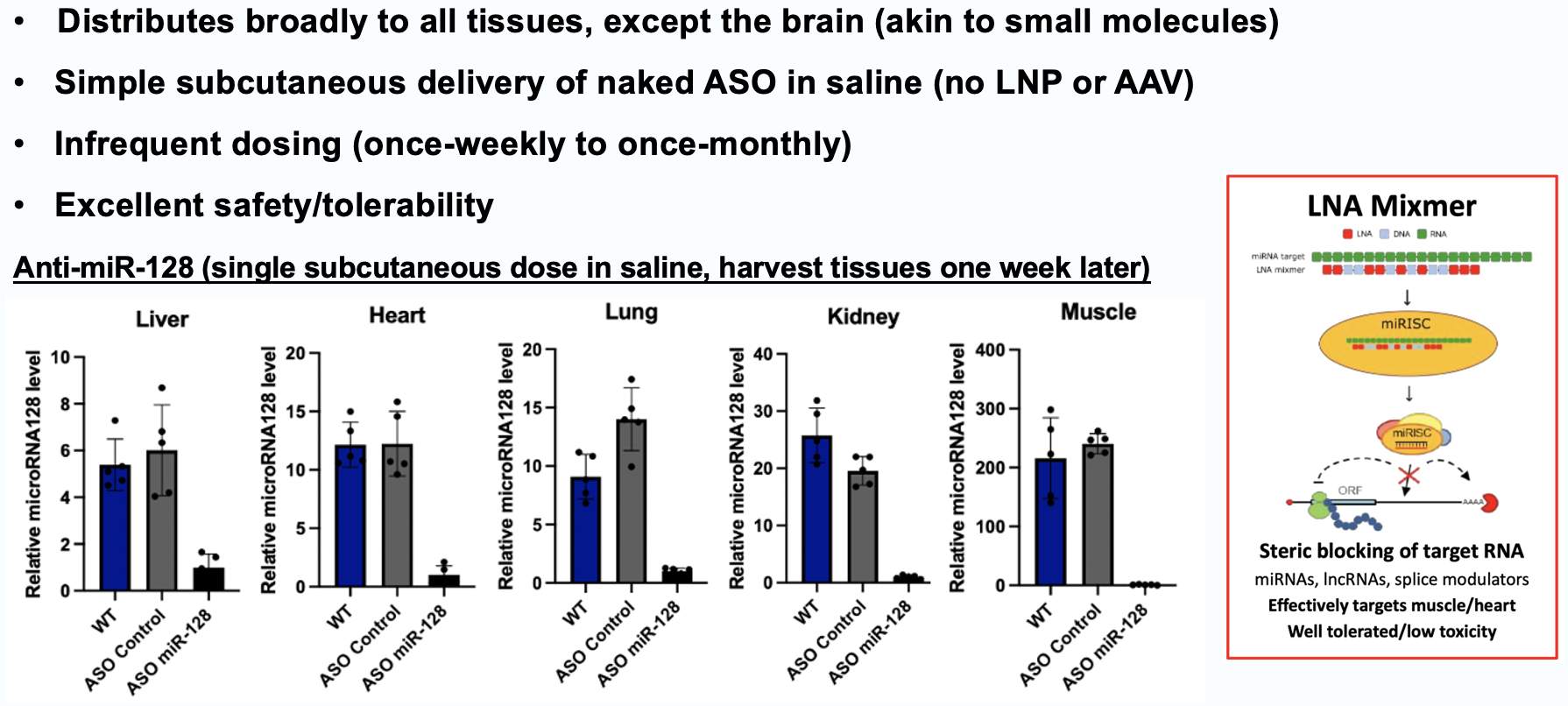
anti-miR-128, miR-128-3p
24-Week NHP Chronic Dosing
Mouse, Pig & NHP Validation
Prospective ASO Design Benchmark
Core Chemistry
Steric-Block LNA Mixmer Chemistry
Elenae's core chemistry is the high-affinity steric-blocking LNA ASO mixmer. The mechanism modulates RNA function through tight occupancy of disease-driving RNA regions, without relying on RNase H cleavage or RISC loading. This profile supports the platform's chronic dosing tolerability observations and enables multiple mechanisms of action from a single chemistry class.
Centerpiece
AI-Guided ASO Design Engine
Purpose: Converts a target sequence and tissue context into optimized LNA mixmer lead candidates.
What it does: Designs small libraries across the chemistry parameter space (target affinity, off-target avoidance, immune avoidance, self-complementarity, tissue permeability, nuclease resistance). Models potency, selectivity, and tolerability risk before synthesis. Built to optimize steric-blocking ASOs across anti-miR, splice-modulating, exon-skipping, and translation-modulating applications.
Modalities Supported
Anti-miR knockdown
Splice modulation
Exon-skipping for previously undruggable transcription factor and protein targets
Translation-modulating applications
Benchmark
In a prospective benchmark on a defined target, the engine produced 2 of 9 designed molecules with picomolar activity in cell-based screens, outperforming a reference ASO that took over a year and more than $1M of empirical screening. One validated benchmark on a single target. Additional program validations are ongoing.
The design engine is the center of the platform. Target selection and tissue-access strategy determine where to apply it and how each program should be advanced.
Supporting Capability
RNA Target Discovery
Target selection integrates GWAS, rare-variant burden, tissue-specific eQTLs, single-cell expression, perturbation screens, and protein interaction networks. Causal inference layers (Mendelian randomization, colocalization) separate causal drivers from passengers. Every candidate is filtered for steric-blockade druggability and for the tissue context the platform can reach. Output is a ranked program brief that feeds into the Design Engine.
Supporting Capability
Tissue-Access Strategy
Each program is matched to a realistic tissue-access route. For tissues where characterized LNA mixmer pharmacology under SC saline is sufficient (heart, skeletal muscle, kidney, lung, retina), the platform proceeds without conjugation. For programs requiring selective tissue or cell-type access, a curated receptor atlas supports shuttle conjugation. Delivery is treated as a per-program design variable rather than a one-size-fits-all platform claim.
Near-complete miR-128 knockdown across heart, skeletal muscle, kidney, and lung after single SC dose in saline. Liver exposure also observed. Includes LNA mixmer mechanism diagram (steric blocking of target RNA).
Strategic Landscape
Two Validation Signals
Oligonucleotide and Tissue-Access Acquisitions
Cardior
$1.1B (Novo Nordisk)
Cardiac LNA mixmer chemistry. Anti-miR-132 in chronic heart failure.
Regulus
$1.7B (Novartis)
Kidney miRNA. 2'-MOE mixmer chemistry.
Avidity
$12B (Novartis)
Muscle-directed oligonucleotide delivery. Late-stage neuromuscular RNA therapeutics. Early-stage precision cardiology programs spun out into Atrium Therapeutics.
AI-Guided Oligonucleotide Design Partnerships
Lilly / Creyon Bio
Multi-target collaboration for AI-guided oligonucleotide design, with deal structure potentially exceeding $1B in total value. Signals pharma interest in AI-native ASO design.
Beyond oligonucleotide-specific deals, AI-enabled drug discovery more broadly has drawn substantial pharma investment (e.g., AstraZeneca's $555M Algen collaboration in functional genomics), reinforcing the broader thesis that AI-native discovery and design platforms are now central to pharma pipelines.
The features driving these transactions (mixmer chemistry, reliable extrahepatic delivery, AI-native design, and chronic dosing tolerability) converge in Elenae's platform. The 2026–2029 strategic window for RNA platform partnering and consolidation remains open.
Problem
Proven Markets, But Delivery Remains the Challenge
Despite proven success, today’s RNA medicine delivery platforms remain limited, complex, and costly.
✗ Multi-component (antibody + linker + oligo) = high COGS
✗ Complex biologics manufacturing
✗ Weak ASO chemistry (PMO)
✗ Receptor-dependent delivery
Elenae’s LNA mixmer chemistry delivers naked in saline to multiple organs without formulation or receptor dependency. The Design Engine codifies that chemistry into a repeatable process for generating optimized ASOs across multiple steric-blockable RNA target classes.